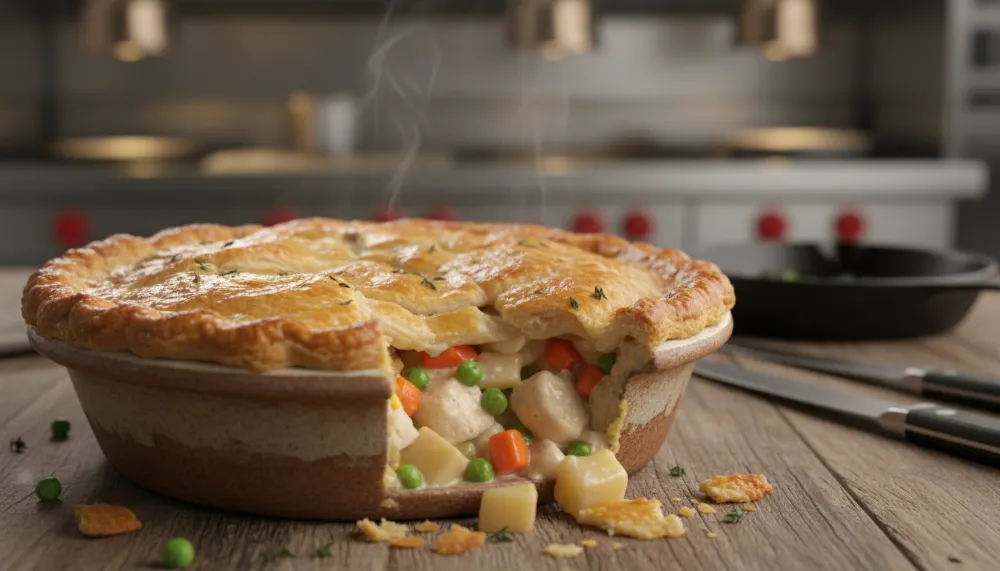
Experience the soul-warming comfort of a perfectly golden Homemade Chicken Pot Pie that defines home cooking at its finest. This timeless classic brings together tender chicken, vibrant vegetables, and a velvety sauce inside the ultimate flaky crust.
Grandma’s Best Homemade Chicken Pot Pie
Ingredients
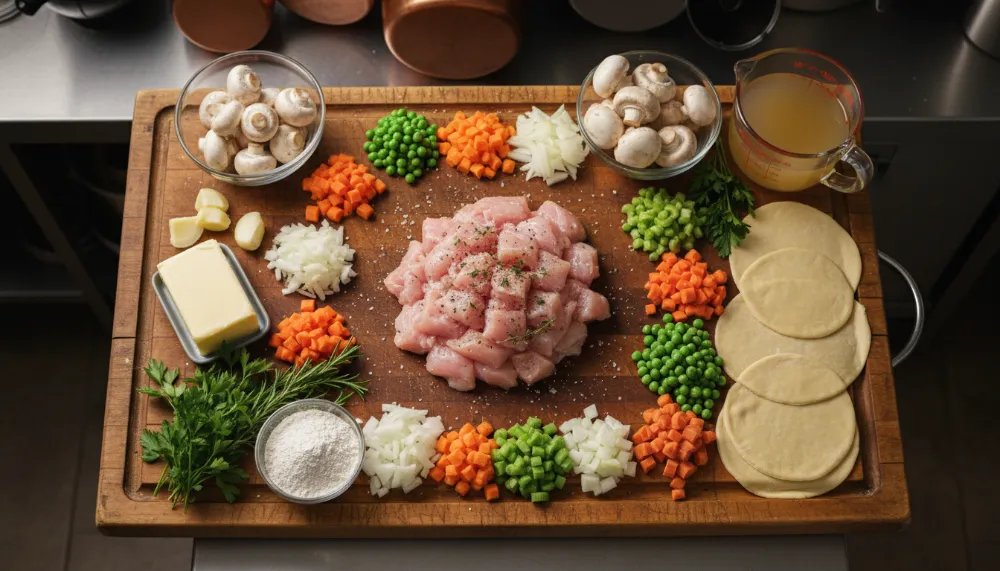
- 1 1 lb Cooked Chicken Breast (Cubed)
- 2 1/2 cup Unsalted Butter
- 3 1/3 cup All-Purpose Flour
- 4 1/2 cup Chopped Onion, Carrots, and Celery
- 5 2 cups Low-Sodium Chicken Broth
- 6 2/3 cup Whole Milk or Heavy Cream
- 7 1 cup Frozen Peas and Corn
- 8 2 Unbaked Pie Crusts
Instructions
- 1 Preheat oven to 425°F (218°C).
- 2 Sauté onions, carrots, and celery in butter until soft. Stir in flour, salt, and pepper.
- 3 Gradually whisk in chicken broth and milk. Simmer until thickened.
- 4 Stir in cooked chicken, peas, and corn.
- 5 Pour mixture into a pastry-lined pie plate. Top with second crust and seal edges.
- 6 Bake for 30-35 minutes until golden brown. Let stand 10 minutes before serving.
The 2,500-Year Journey of Homemade Chicken Pot Pie
When you take a bite of a steaming Homemade Chicken Pot Pie, you are participating in a culinary tradition that predates most modern empires. The history of this dish is a fascinating look at how human ingenuity turned preservation into art. While we associate it today with American diners and cozy winter nights, its roots are firmly planted in Ancient Greece. The Greeks developed a dish called Artocreas, which was essentially an open-faced pastry shell filled with meat. However, it was the Romans who took this a step further by adding a top crust, though in those days, the crust was often a thick, inedible paste of flour and water designed solely to keep the meat moist during the cooking process.
As the Roman Empire expanded, so did the concept of the meat pie. By the Middle Ages, the English had transformed these into “coffyns,” ornate pastry structures that were served at royal banquets. One of the earliest documented recipes for something resembling a Homemade Chicken Pot Pie appears in King Richard II’s cookbook from 1390. Over time, as ingredients became more accessible and pastry techniques improved, the crust became just as vital and delicious as the filling. European settlers eventually brought these techniques to the United States, where the dish became a staple of early American homesteading because it allowed families to stretch a single chicken into a hearty meal for eight people.
The Anatomy of the Perfect Crust
The defining characteristic of a superior Homemade Chicken Pot Pie is undoubtedly the crust. It must be structurally sound enough to hold a heavy, creamy filling, yet light and flaky enough to shatter at the touch of a fork. Achieving this balance requires an understanding of fat-to-flour ratios and the temperature of your ingredients. Many home cooks make the mistake of using room-temperature butter, which results in a crumbly, sandy texture rather than distinct, buttery layers. To get that iconic flakiness, your butter must be ice-cold. When the cold butter hits the hot oven, the water within the butter evaporates quickly, creating small pockets of steam that lift the layers of flour.
For a consistent result every time, I recommend the Cuisinart 8 Cup Food Processor: https://amzn.to/47Nhbg8. It is a meal prep essential that allows you to pulse the butter and flour together in seconds, preventing your hands from warming up the dough. Once your dough is formed, a long rest in the refrigerator is mandatory. This allows the gluten to relax and the moisture to distribute evenly, ensuring your crust doesn’t shrink when it hits the heat. If you want a more rustic feel, you can even top your Homemade Chicken Pot Pie with drop biscuits or a golden cornbread crust, particularly if you are leaning toward a more Southern-inspired flavor profile.
Mastering the Filling: A Lesson in the Roux
The soul of a Homemade Chicken Pot Pie lies in its gravy. A thin, watery filling is the most common pitfall in pot pie construction. To avoid this, you must master the blonde roux. This starts with equal parts butter and flour, cooked just long enough to remove the raw flour taste but not so long that it begins to brown. A blonde roux provides the thick, velvety base that holds the chicken and vegetables in suspension. When adding your liquids, use a combination of high-quality chicken broth and heavy cream. Because this recipe strictly avoids alcohol, we rely on the richness of the dairy and the depth of the broth to provide complexity. A splash of apple cider vinegar or lemon juice at the very end of the simmering process can provide that bright acidity usually offered by wine.
If you are looking to roast your chicken or vegetables before they go into the pie to enhance their natural sugars, the Cosori 9-in-1 TurboBlaze Air Fryer 6 Qt: https://amzn.to/4hRWmVq is a game changer. Its large family capacity allows you to roast an entire batch of carrots and celery to caramelized perfection in half the time of a standard oven. This extra step adds a layer of depth to your Homemade Chicken Pot Pie that separates a standard meal from a gourmet experience.
Nutritional Breakdown: What’s Inside Your Pie?
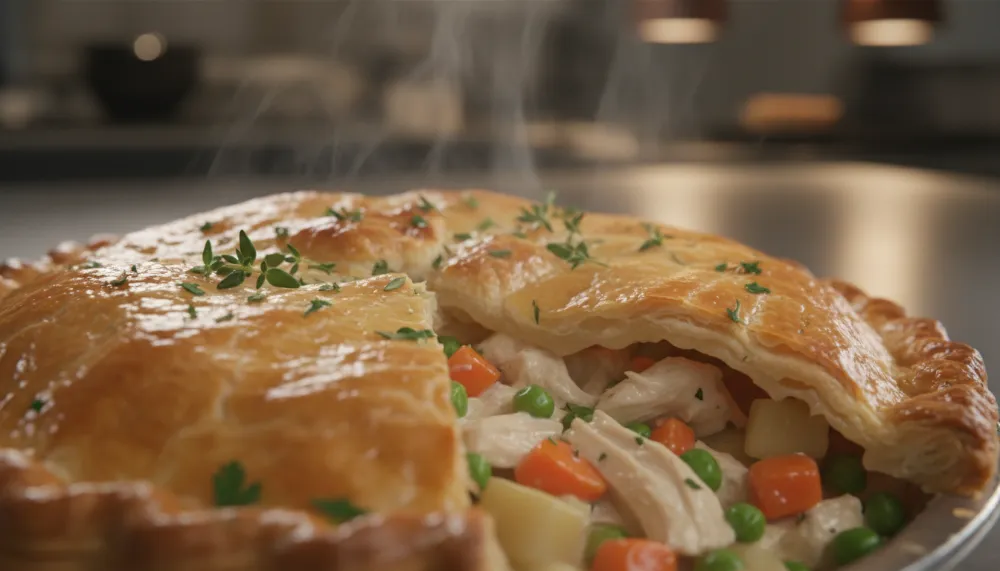
While often viewed as a purely indulgent treat, a Homemade Chicken Pot Pie is actually a remarkably balanced meal when made from scratch. A typical serving provides a significant amount of protein, roughly 15g to 22g, which is essential for muscle repair and satiety. The carrots and peas contribute a healthy dose of Vitamin A and Vitamin K, while the onions and celery provide prebiotic fibers that support gut health. By making your pie at home, you also gain control over the sodium content, which is notoriously high in frozen or store-bought versions. Using a low-sodium broth and seasoning with fresh herbs like thyme and rosemary allows you to maximize flavor without the health drawbacks of excessive salt.
Creative Variations for Every Palate
The beauty of the Homemade Chicken Pot Pie is its versatility. Once you have mastered the basic formula, you can begin to experiment with different flavor profiles that adhere to all dietary requirements. For those who crave a smoky undertone but avoid pork, the Savory Beef-Smoked variation is a perfect choice. By using finely diced beef-based bacon, you can render out a smoky fat to start your roux, giving the entire pie a woodsy, campfire aroma. Combine this with smoked paprika and roasted garlic for a truly robust experience.
Alternatively, the Japanese Curry variation replaces the traditional herb gravy with a warm, spiced curry base. Using the Ninja BN751 Professional Plus DUO Blender: https://amzn.to/3LCDyNR, you can create a perfectly smooth curry sauce by blending apple purée and onions into the broth, providing the sweetness and thickness traditional in Japanese comfort food. This version pairs beautifully with a light, airy puff pastry lid, providing a wonderful textural contrast to the dense, aromatic filling.
Storage and Freezing: Prepping for the Future
Homemade Chicken Pot Pie is the ultimate make-ahead meal. You can assemble the entire pie and freeze it unbaked for up to three months. When you are ready for a quick dinner, simply bake it directly from frozen, adding an extra 15-20 minutes to the cooking time. To prevent freezer burn and keep your ingredients tasting fresh, the FoodSaver Vacuum Sealer Machine: https://amzn.to/4qWgVnS is an invaluable tool, especially for preserving the chicken and vegetables before assembly. For leftovers, the Rubbermaid Brilliance Glass Storage Set of 9: https://amzn.to/4oD0YkY is perfect because the leak-proof lids ensure the gravy stays inside the container and the glass allows you to reheat the pie in the oven or microwave without losing that precious crust texture.
Final Tips for Success
To ensure your Homemade Chicken Pot Pie is a success every time, remember to vent the top crust. If you don’t cut small slits in the top, the steam from the filling will build up and cause the crust to become soggy or even burst. Additionally, always let the pie sit for at least ten minutes after removing it from the oven. This “rest” period allows the gravy to set, ensuring that when you slice into it, you get a beautiful, cohesive portion rather than a puddle of sauce. With these techniques and tools in hand, you are ready to create a masterpiece that will be the centerpiece of any family gathering.