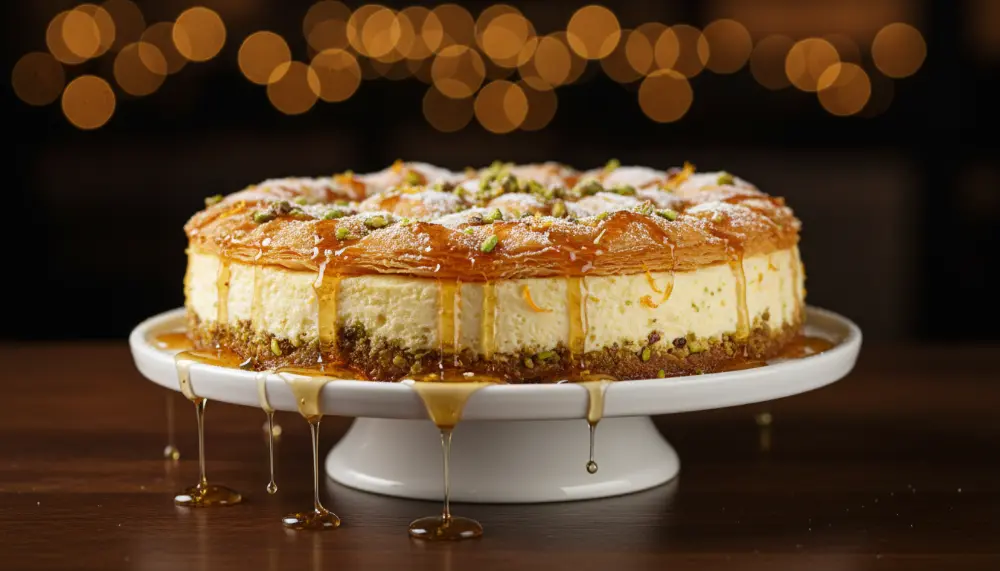
Experience the divine marriage of crunchy, honey-soaked pastry and velvet-smooth cream with our authoritative guide to the perfect Baklava Cheesecake. This show-stopping dessert is the ultimate centerpiece for any sophisticated gathering, combining Mediterranean tradition with modern decadence.
Signature Baklava Cheesecake
45 MIN
65 MIN
12 PERS
Ingredients
- 1 16 oz package Phyllo dough (thawed)
- 2 1 cup Unsalted butter (melted)
- 3 2.5 cups mixed Walnuts and Pistachios
- 4 24 oz Full-fat cream cheese
- 5 1 cup Granulated sugar
- 6 1 cup Sour cream
- 7 3 Large eggs (room temperature)
- 8 1 tbsp Alcohol-free vanilla flavoring
- 9 3/4 cup Honey and 1/2 cup Water (for syrup)
Instructions
- 1 Prepare honey syrup by boiling water, sugar, and honey; cool completely.
- 2 Pulse nuts in a processor and mix with cinnamon.
- 3 Layer 8-10 buttered phyllo sheets in a springform pan, rotating for coverage.
- 4 Whip cream cheese, sugar, and eggs into a smooth batter.
- 5 Alternate layers of nut mixture and batter within the phyllo crust.
- 6 Bake at 325°F for 65 minutes; pour cold syrup over hot pastry edges immediately after baking.
The Cultural Synthesis of Baklava Cheesecake
The culinary world is often defined by its ability to merge distinct traditions into a singular, cohesive masterpiece. The Baklava Cheesecake is the epitome of this evolution. By taking the centuries-old technique of layering tissue-thin phyllo pastry with spiced nuts and combining it with the rich, dairy-heavy profile of a New York-style cheesecake, we create a dessert that appeals to both the crunch-lover and the custard-enthusiast. This fusion isn’t just about taste; it is about the structural engineering of food. The moisture of the cheesecake batter must be carefully managed so it doesn’t compromise the crystalline structure of the buttered phyllo layers. Achieving this balance requires a deep understanding of temperature gradients and ingredient quality. When you set out to make a Baklava Cheesecake, you are not just baking; you are orchestrating a complex interplay of textures that ranges from the shatteringly crisp to the silkily dense.
Essential Kitchen Tools for Success
To ensure your Baklava Cheesecake reaches professional standards, you must utilize tools that can handle precision tasks. For instance, the nut mixture requires a specific consistency, not a paste, but a fine crumble. I highly recommend using the Ninja BN751 Professional Plus DUO Blender for pulsing your walnuts and pistachios. Its 1000W motor provides the control needed to avoid over-processing. Furthermore, for the cheesecake filling, the Cuisinart 8 Cup Food Processor is a meal prep essential that ensures your cream cheese is aerated and lump-free, which is critical for that velvety mouthfeel.
Mastering the Phyllo Foundation
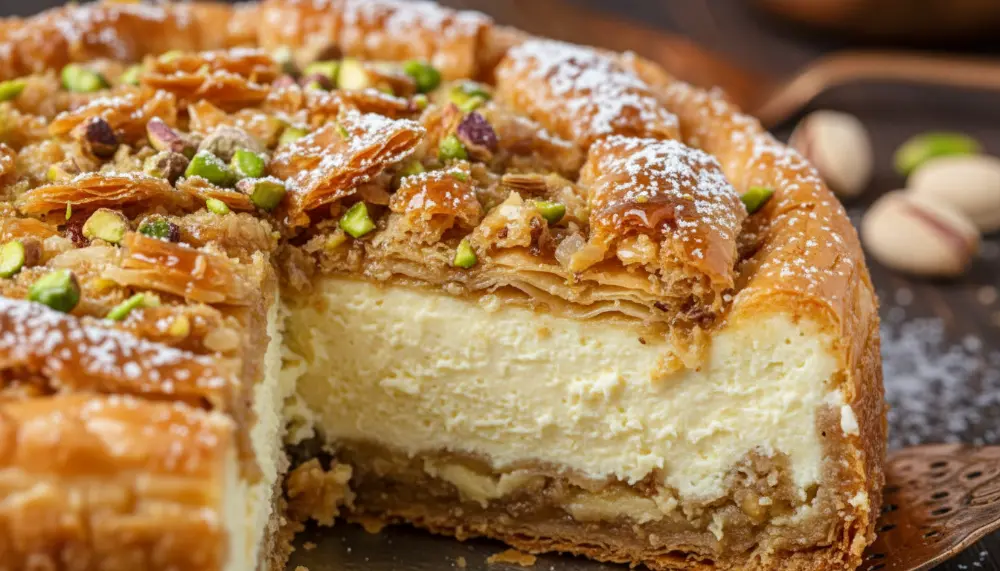
Working with phyllo is perhaps the most daunting aspect of the Baklava Cheesecake process for many home bakers. Phyllo is notoriously temperamental; it dries out within minutes of exposure to air. To master this, you must keep your pastry sheets under a lightly damp towel at all times. Each sheet must be meticulously brushed with high-quality melted butter. This butter serves two purposes: it acts as a barrier against moisture from the batter and creates the “lamination” effect during baking, where the water in the butter evaporates and pushes the thin layers apart, creating that signature baklava crunch. If you are roasting your nuts beforehand to deepen their flavor, the Cosori 9-in-1 TurboBlaze Air Fryer 6 Qt is perfect for a quick, even toast without the risk of burning that often occurs in traditional ovens.
The Science of the Honey Syrup
The crowning glory of any Baklava Cheesecake is the syrup. Unlike a standard simple syrup, a honey-based reduction adds a floral complexity and a viscous coating that preserves the pastry’s integrity. The golden rule of baklava is “Opposite Temperatures.” You must pour cold syrup over a hot cake, or hot syrup over a cold cake. For this recipe, we pour cold syrup over the piping-hot Baklava Cheesecake the moment it exits the oven. This creates a thermal shock that allows the syrup to be drawn deep into the layers without making them soggy. If both are hot, the pastry will turn to mush; if both are cold, the syrup will simply sit on top and fail to penetrate the nut layers.
Step-By-Step Technical Breakdown
When assembling your Baklava Cheesecake, focus on the layering sequence. Start with the base of 10 sheets of phyllo. Do not worry about them being perfectly flat; the folds and crinkles actually add to the textural variety. After the base, add a generous layer of the nut mixture. This acts as a foundation for the first half of the cheesecake batter. The middle layer of phyllo inside the cake is a secret trick, it provides a structural “shelf” that prevents the nuts from sinking to the bottom, ensuring every bite of your Baklava Cheesecake has an even distribution of spice, nuttiness, and cream.
Ensuring a Crack-Free Surface
Cheesecakes often fail due to rapid temperature changes or over-mixing. To prevent cracks in your Baklava Cheesecake, ensure all your ingredients, the cream cheese, eggs, and sour cream, are at true room temperature. Cold ingredients do not emulsify; they require more agitation to smooth out, which introduces air. Air bubbles expand in the oven and then collapse, causing the surface to split. Additionally, when the bake is finished, turn off the oven and leave the door slightly ajar for at least 30 minutes. This gradual cooling period is vital for the Baklava Cheesecake to set its structure without the stress of a sudden chill.
Troubleshooting Common Baklava Cheesecake Issues
Is your crust soggy? This usually happens if the butter was not applied thoroughly to the edges or if the honey syrup was applied too aggressively to the center rather than the phyllo perimeter. Another issue is the “leaking” springform pan. Because we use melted butter and a liquid batter, a tight seal is necessary. If your pan is older, wrap the exterior in heavy-duty foil before placing it in the oven. For storage, avoid plastic wrap directly on the surface as it traps moisture and softens the phyllo. Instead, use a high-quality glass container like the Rubbermaid Brilliance Glass Storage Set of 9, which provides an airtight seal without making the pastry sweat. This is the best way to keep your Baklava Cheesecake leftovers fresh for up to five days.
Why Quality Ingredients Matter
Because this recipe relies on simple, bold flavors, there is nowhere to hide poor-quality ingredients. Use local honey if possible; the terroir of the honey, whether it is clover, wildflower, or orange blossom, will drastically change the finish of your Baklava Cheesecake. Similarly, choose the highest fat content cream cheese available. Low-fat versions contain more water and stabilizers, which can lead to a grainy texture. For the vanilla, since we are avoiding alcohol, a glycerin-based vanilla flavoring or scraping a fresh vanilla bean is the only way to achieve that deep, aromatic scent that cuts through the richness of the cheese. For more information on sourcing and advanced techniques, visit our recipe index for comprehensive guides.
The Final Presentation
Before serving your Baklava Cheesecake, give it one final drizzle of warmed honey and a dusting of bright green pistachios. The visual contrast between the golden-brown phyllo, the white cream filling, and the green nuts is stunning. Slice it with a very sharp, thin-bladed knife dipped in hot water to get clean edges through the crispy pastry. This Baklava Cheesecake is more than just a dessert; it is a testament to the beauty of cross-cultural culinary innovation. Whether you are a seasoned pastry chef or a dedicated home baker, following these technical steps will result in a Baklava Cheesecake that is truly high-authority in both flavor and form.